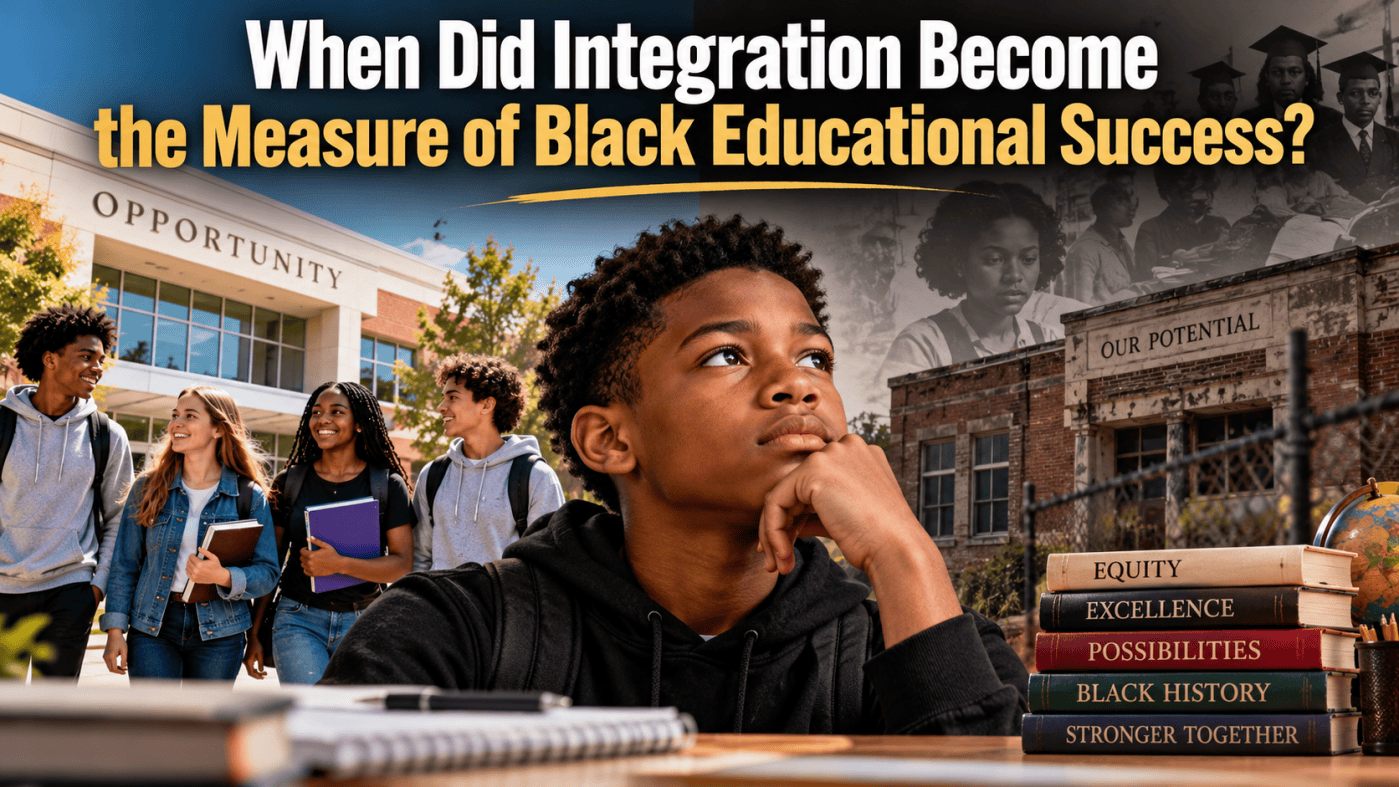
Let me start by saying something that may disappoint people who are already ready to argue with the title:
I believe integration has produced important and positive gains for Black Americans. Soooo…. To be clear!
- I am not arguing for a return to segregated schools.
- I am not arguing that Black children shouldn’t attend schools with White children. That’s how I was raised and educated myself and I got a LOT of value and some good friends from that!
- And I am certainly not arguing that integration itself is bad.
I’m questioning something else.
I’m questioning what we’ve been taught to believe integration means.
Because sometimes the most powerful assumptions aren’t the ones people say out loud.
They’re the ones we stop questioning.
Why Is the White School So Often the Destination?
There is a paradox when we talk about why schools are failing!
When a predominantly Black school is struggling, one of the explanations we’re likely to hear is segregation.
- We’re told that Black children are concentrated in high-poverty schools.
- We’re told that racial isolation is harmful to them.
- We’re told that Black students need access to schools with greater resources and different peer environments.
Some of those arguments are valid and have substantial evidence behind them.
But here’s the question:
Why don’t we ask the same question or give the same explanations when predominantly White schools struggle?
When a predominantly White school has problems, we can talk about……
- Funding.
- Leadership.
- Teacher shortages.
- Curriculum.
- Declining enrollment.
- State policy.
- Community conditions.
But we don’t usually look at the racial composition of the school and say: “Maybe the problem is that there aren’t enough Black children here.”
Why?
That’s what I want us to think about.
Because if the solution to a struggling Black school system is repeatedly described as getting Black children into predominantly White schools, we can unintentionally create a very powerful message:
- The White school is the good school.
- The Black school is the bad school.
And Black children need to move from one to the other.
That is where I believe we need to stop and examine our thinking. Because if we view one set of schools as more valuable that the other, then we make real decisions with our tax dollars as to where to invest.
What Are We Really Saying About Black Schools?
Here’s a question I don’t hear often enough:
Can a predominantly Black school be excellent simply because it is excellent?
- YES: If the school itself is well funded, well led, academically rigorous, safe, stable and filled with talented educators who believe in the children?
Why shouldn’t that be the standard?
This is where I believe our conversation needs to change.
Because integration and educational excellence are not the same thing.
- They can overlap.
- They can reinforce one another.
- But they are not synonymous.
Black Children Shouldn’t Have to Leave Black Spaces to Find Excellence
This is perhaps the part that makes people uncomfortable.
For generations, Black Americans were denied access to institutions, neighborhoods, schools and opportunities because of racism and segregation.
YES: Integration became an important pathway toward equal access.
That history matters.
But here’s what I don’t want us to lose:
- Black people also built excellent institutions while being excluded from White ones.
- Black schools produced scholars.
- Black teachers educated generations of children.
- Black colleges and universities produced leaders.
- Black communities created businesses, organizations, churches, professional networks and cultural institutions.
They did not become valuable because White people made them valuable or endorsed them.
They were valuable because Black people made them valuable.
So why shouldn’t we expect the same from our schools? Why shouldn’t Black People expect the same of each other???
Why shouldn’t a predominantly Black school be thought of as capable of producing excellence?
And Here’s the Part We Don’t Talk About Enough
We spend a great deal of time discussing what Black children gain from being around White children.
But how often do we have the opposite conversation?
What do White children gain from being around Black children (and learning “Black” history)?
- What do they learn?
- What relationships do they develop?
- What assumptions might be challenged?
- What experiences might broaden their understanding of America?
- What do they learn about Black history and culture from actually knowing Black people rather than simply reading about them?
- What would they begin to think about or treat Black People when they learn early on that a LOT of American Heroes, those who fought for and gave their life for Freedom were Black!
- And what happens when Black culture, Black history and Black perspectives aren’t treated as something students merely need to be exposed to—but as something that has genuine value?
Or said another way:
- It has been made VERY clear to Black Parents that their children benefit from going to school with White Kids.
- We need to drive and expand a counter narrative to White Parents that there is a benefit to their children being around Black Kids.
What Happens When Integration Becomes Assimilation?
Here’s where I become concerned.
There is a difference between integration and assimilation.
- Integration says: We can be different and still belong together as equals.
- Assimilation says:
- You can belong as long as you become more like us.
- You can belong as long as you stay in your lanes and make us feel safe!
Those aren’t the same thing.
If integration means Black children entering predominantly White institutions and being expected to conform to the culture, expectations and norms already established there, then we should at least be honest about what we’re asking!
- Are we integrating?
- Or are we asking Black children to adapt (Assimilation)?
- And if we are asking them to adapt, why is their culture the thing that needs adapting?
- Why isn’t the goal a genuine exchange?
- Why can’t Black children bring something to the table too?
Or said another way: Are we teaching everyone that Black Culture/Norms are awful and White Culture/Norms are superior to that?
Which is a lead in to talk about “White Supremacy”
White supremacy doesn’t always announce itself or show up as hatred.
Sometimes it can appear as a seemingly innocent or innocuous assumption about:
- What is normal
- What is desirable
- What is successful
- What is sophisticated
- What is safe
- What is worth emulating
- What is worth investing in
And if we unconsciously assume that predominantly White schools are inherently better than predominantly Black schools, we have created a hierarchy whether we intended to or not.
That’s the part I want us to examine.
Imagine Flipping the Conversation
Imagine if we talked about integration differently.
- Instead of just saying: “Black children need access to White schools.”
- We asked: “Why are we allowing any school—Black, White, Latino, Asian or otherwise—to remain under-resourced?”
Instead of assuming that the answer is moving Black children somewhere else, we asked:
“Why can’t we make the schools serving Black children excellent?”
Instead of asking how many Black children can get into predominantly White schools, we asked:
“What would it take to make predominantly Black schools places where families actively want their children to attend?”
Now we’re having a different conversation.
Integration Should Expand Opportunity—Not Define Excellence
I don’t want Black parents (or children) to have to choose between Black identity and educational excellence. I want them to get that they can have BOTH at the same time!
I don’t want a Black child to hear, explicitly or implicitly: “If you want to be successful, you need to get away from here.”
This message does NOT serve our children or our community.
The goal should be something much bigger.
- Every school should have the opportunity to be excellent.
- Every child should have access to quality academics.
- Every community should have quality teachers.
- Every child should have access to advanced courses, technology, extracurricular activities and safe learning environments.
- And children should have opportunities to develop meaningful relationships across racial and cultural lines.
So What Do I Actually Want?
- I want us to stop treating predominantly Black schools as inherently deficient.
- I want us to stop assuming that Black children must leave Black schools to find excellence.
- I want us to recognize the historical reasons integration mattered while still being willing to question the framework through which we understand it today.
And most importantly: I want Black communities to believe that we can build excellent institutions too.
The Question Isn’t Whether or not we Need Integration
Maybe the better question is:
What kind of integration do we want?
- Integration where Black children are viewed as recipients and White institutions are viewed as providers?
- Or integration where Black and White children are viewed as equally valuable participants?
- Integration where Black children are told what they need to learn from White America?
- Or Integration where everyone has something to learn from everyone else?
Those are very different visions.
And I believe we need to have that conversation.
Because integration should never require us to believe that Black spaces are inherently inferior.
And educational equality should never require Black children to stop being Black.
The ultimate goal shouldn’t be for Black children to gain entry into somebody else’s definition of excellence.
The goal should be to make excellence available everywhere.
And perhaps that’s the conversation about integration we’ve been missing.
Discover more from Quiet Thunder
Subscribe to get the latest posts sent to your email.


You must be logged in to post a comment.